
Rebar for Gravel: The Engineering Behind Cellular Confinement
Why a confined gravel layer behaves like a structural slab — and what that means for your arena, paddock, round pen, driveway, or parking pad.
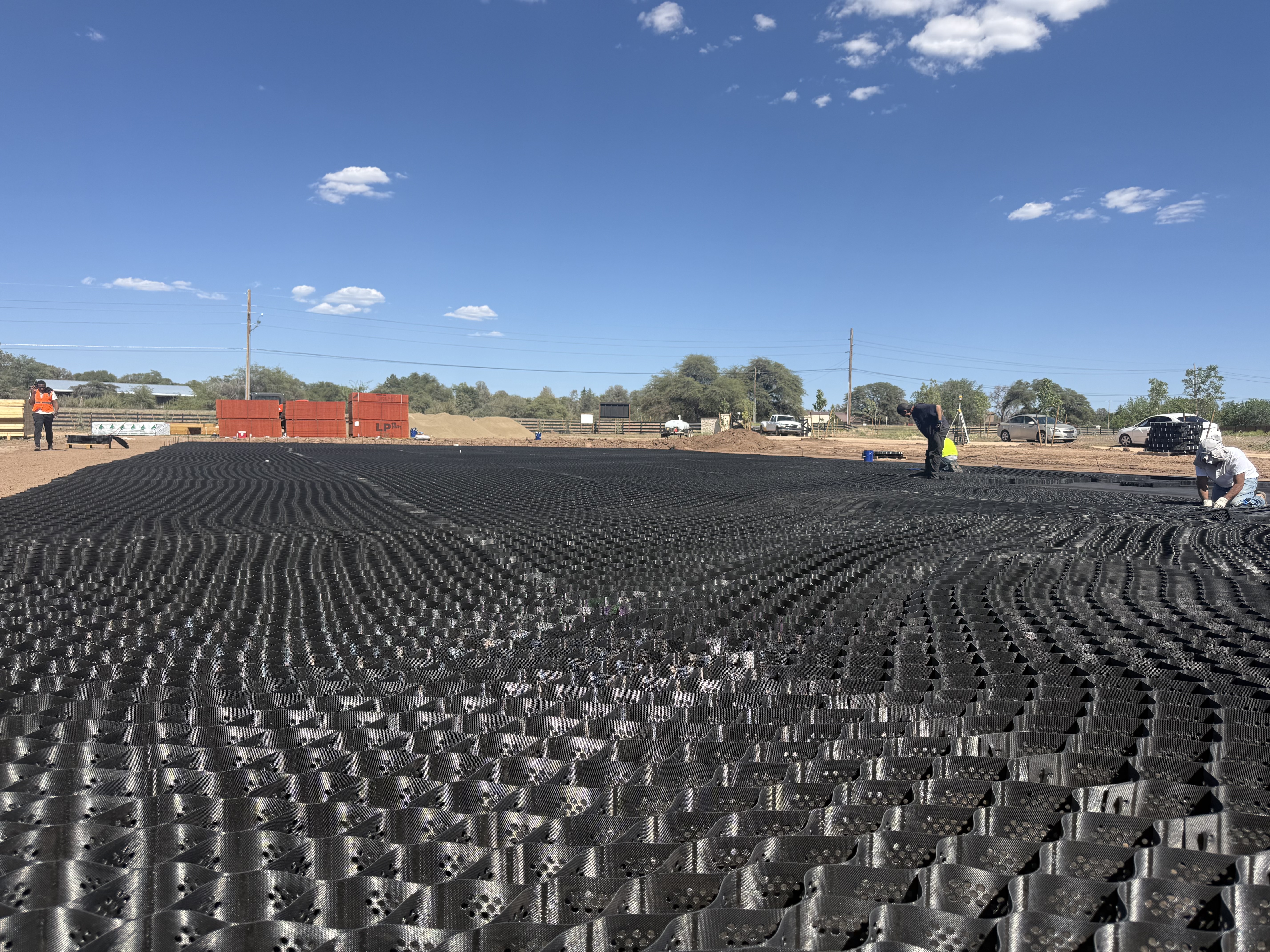
Pour concrete without rebar and it cracks under load. The steel doesn't make the concrete harder — it gives it something concrete can't generate on its own: tension and confinement. Cellular confinement does the same job for gravel. A geocell layer doesn't change what your aggregate is; it changes how the aggregate behaves under a hoof, a tire, or a horse trailer — turning loose, shifting stone into a stiff, load-spreading mat.
That distinction matters, because most people first hear about geocell as a drainage product. Drainage is a benefit, but it isn't the reason the technology was invented, and it isn't why it works under a round pen rail or a gravel drive. The real story is structural. Here's the engineering, the evidence, and where it actually pays off.
What this means for horse properties
If you own or manage an equestrian facility, the surfaces your horses ride on, stand on, and travel across are only as good as the base underneath them. An outdoor arena that ruts and holds water, a paddock gateway that turns to soup in spring, a round pen with a worn rail track, or a gravel drive that potholes under feed delivery trucks — these are all base-failure problems. Cellular confinement is the structural layer that helps keep those surfaces flat, drainable, and durable. This article explains exactly how it works and what to look for when you specify it.
In this article
- Where the idea came from
- How confinement actually works
- The payoff: spread the load, save the subgrade
- Where it matters on a horse property
- Where BaseCore fits
- How BaseCore compares to other geocell
- Straight talk on the numbers
- Frequently asked questions
01 — Where the idea came from
Cellular confinement wasn't dreamed up for landscaping. In the mid-1970s, the U.S. Army Corps of Engineers' Waterways Experiment Station needed a way to drive heavy vehicles across soft, sandy ground that would normally swallow a truck. Steve Webster's team developed interconnected "sand grids" that confined the loose sand — and found the confined sand outperformed conventional crushed stone over weak soil (peer-reviewed: Webster, USACE Technical Report GL-79-20, 1979).
Fifty years later the material has improved — modern systems use welded polymer cells instead of fabric grids — but the principle is unchanged: confine the fill, and the fill carries load like a structural element.
02 — How confinement actually works
Loose aggregate fails in a predictable way. Press down on it and the particles shove sideways, the surface ruts, and individual stones punch down into soft soil below. Geocell interrupts every step of that failure with three linked mechanisms.
Hoop stress in the cell walls. When a load presses on the fill inside a cell, the fill tries to spread outward and pushes on the cell walls. The walls resist radially — developing hoop stress, the same way a band around a barrel holds the staves together. Stiffer, well-welded walls develop more hoop resistance, which tends to mean more confinement.
Passive resistance from the neighbors. No cell works alone. As a loaded cell tries to bulge outward, it presses against the filled cells beside it, which push back through passive earth pressure. Radial load testing indicates that the number of connected cells and the stiffness of the cell material are among the dominant factors in how much confinement you get.
The mattress (or slab) effect. Add those together across a whole panel and the interconnected, filled cells stop behaving like loose grains and start behaving like a stiff composite mat — a beam or slab that bends as a unit. In full-scale wheel-load testing at the University of Kansas, researchers observed exactly this: a thicker confined base "behaved as a slab," spreading load rather than punching through (peer-reviewed: Han et al., J. Materials in Civil Engineering, 2011).

A loaded cell develops hoop stress in its walls and is braced by passive resistance from the cells around it. The result is a stiff, interconnected mat.
03 — The payoff: spread the load, save the subgrade
Because the confined layer is stiffer than loose stone, it spreads each load over a wider footprint before that load reaches the soil underneath. A wider footprint typically means lower peak stress on the subgrade — the soft, expensive-to-fix layer you most want to protect. In the Kansas wheel-load study, confinement "reduced the vertical stresses at the interface between base and subgrade" compared with the same base unreinforced (peer-reviewed).

Conceptual — illustrative, not to scale. Loose aggregate channels load into a narrow, deep column; a confined layer distributes it across a wider, shallower zone, generally lowering peak stress on the subgrade.
Three structural benefits tend to follow directly from that load-spreading behavior:
- ~1.9–3.2× bearing-capacity improvement for confined sand (peer-reviewed, Kansas program), with stiffness factors of ~1.2–2.0× over the same granular base.
- Up to ~19× more load cycles to a 75 mm rut for a confined base vs. unreinforced (peer-reviewed: Thakur et al., 2012) — a best-case figure; others in the same study were ~3.6× and ~6.4×.
- ~14–50% base-aggregate thickness reduction for comparable capacity (condition-dependent range across multiple studies) — it depends heavily on soil, fill, and cell geometry.
The headline result: in repeated-wheel testing, a thin (15 cm) sand base with a little gravel cover couldn't survive one truck-axle pass unreinforced — but with cellular confinement the same base held to under 5 cm of rut after 5,000 passes (peer-reviewed: Yang, Han, Pokharel et al., 2011–2012). That's the structural case in a single sentence.
04 — Where it matters on a horse property
Everything above translates cleanly to the surfaces under your boots and hooves. The common thread: these are load-bearing problems first, and most don't depend on drainage to justify a confined base.
- Outdoor arena base — confinement helps hold the base flat and rut-resistant so the footing depth above stays more consistent, which keeps a surface riding more similarly in the corners as on the centerline. It also helps reduce base stone migrating into and mixing with the subgrade over time.
- Paddocks & turnout — high-traffic gateways, feeders, and water troughs are where footing churns into mud. A confined gravel pad helps carry hoof load across the panel instead of pumping stone down into soft ground.
- Round pens — the rail track takes thousands of repetitive, concentrated impacts in a tight circle, exactly the cyclic-rutting scenario the research targets. Confinement helps resist the worn groove that tends to form on an unstabilized rail line.
- Driveways & lanes — trucks, trailers, and tractors are heavy point loads. A confined base spreads them, helping resist the washboarding and potholing that loose gravel tends to develop, often with less stone than an equivalent unconfined build.
- Parking & trailer pads — static and slow-rolling heavy loads over a footprint you want to stay level and firm: a textbook confinement application, gravel or grass-filled.
In every case the footing or surface you actually ride on or park on sits above the confined layer. BaseCore is the structural foundation; a correctly graded, sand-first riding surface (and any footing tuning that goes with it) lives on top. The base and the cushion do different jobs, and getting the base right is what helps the cushion stay where you put it.
05 — Where BaseCore fits
BaseCore is a welded, perforated cellular confinement system made from virgin, UV-stable HDPE — available in two tiers, BaseCore HD and BaseCore Std — connected with engineered BaseClips™ and anchored with flush BaseCaps™ rather than exposed bent rebar. The perforations let water move through the walls, so confinement and drainage aren't a trade-off.
The mechanism described in this article — hoop stress, passive resistance, the mattress effect, load spreading — is the general behavior of polymer geocell, and it's the behavior BaseCore is built to deliver. We're deliberate about not borrowing performance numbers from other materials: many of the most quotable figures in the literature come from specialized high-modulus polymer alloys, and those specific magnitudes shouldn't be claimed for an HDPE product. What HDPE confinement tends to bring to your property is a stiffer base, lower subgrade stress, less rutting, and a level surface that stays level.
06 — How BaseCore compares to other geocell
Not all geocell is built the same, and the differences are often the ones that decide whether a base holds up. Here's where BaseCore separates from commodity products — and we've kept the spec figures to what's on the product sheets, with the honesty notes attached.

BaseCore HD and Std compared with a typical commodity geocell across the specs that drive performance. Design-life figures are manufacturer ratings, not independent test results.
A few of those rows are worth saying plainly:
- An HD tier most competitors don't offer. BaseCore comes in two grades, including a reinforced HD build with the tightest cells and weld spacing. Many commodity products are sold in a single, lighter grade with no heavy-duty option.
- Tighter cells, not bigger ones. Confinement comes from the cell walls bracing the fill. Smaller cells put more wall around every bit of aggregate, so BaseCore HD's 7.2 × 6.0 in cell tends to confine more aggressively than the ~12.5 × 10.6 in openings common on competing products. Bigger cells are cheaper to ship and faster to lay — and they tend to confine less.
- Virgin material, not recycled blends. BaseCore is virgin, UV-stable HDPE with a known, consistent formulation. Many imported products use recycled or blended polymer, where wall strength and UV durability can vary batch to batch.
- Thicker walls, double-welded seams. The seam is where a geocell tends to fail first under load. BaseCore uses industrial double-welded seams on a thicker wall (1.5–1.7 mm) versus the single-welded or glued seams and 1.27 mm-or-thinner walls typical of budget geocell.
- Perforations that help with drainage. BaseCore's perforated walls let water move laterally through the system. In many builds that can reduce or remove the need for a separate French-drain network — though how far you can rely on it still depends on your subgrade's permeability and slope, so it's a site-by-site call, not a universal rule.
- Based in the USA. BaseCore is U.S.-based, which generally means shorter lead times, domestic support, and accountability for what's in the resin — versus the often-imported commodity supply.

The wall does the work. Tighter cells, a thicker double-welded seam, and through-wall perforations are what separate a structural confinement system from a commodity grid.
Straight talk on the numbers
We'd rather you trust our claims than be dazzled by them, so here's how to read the evidence above:
- The mechanism is settled science. Confinement, hoop stress, and load spreading are well established across decades of peer-reviewed geotechnical research.
- The exact numbers are not universal. Improvement factors in the literature range from under 2× to over 11× — driven largely by how soft the subgrade is, what fill you use, and the cell geometry. The biggest gains tend to show up over the weakest soils with clean granular fill.
- Much of the strongest lab data is manufacturer-funded. The Kansas studies are credible and peer-reviewed, but several were sponsored by a geocell maker. We flag that rather than hide it.
- Spec-sheet figures are manufacturer ratings. Design-life numbers (ours and competitors') are ratings, not independent field results, and the "typical competitor" column reflects common commodity specs that vary by product.
- Lab and field aren't identical. Accelerated wheel-load tests are full-scale but not the same as years of service. Real-world results depend on your build.
The honest summary: cellular confinement is a well-supported way to help a granular layer behave more structurally. How much it helps your surface depends on your soil, your loads, and how it's installed — which is exactly the conversation worth having before you order.
Frequently asked questions
Is geocell mainly a drainage product or a structural one?
Cellular confinement was invented as a structural solution for driving heavy vehicles over weak soil (U.S. Army Corps of Engineers, 1970s). Drainage is a real benefit when the cell walls are perforated, but the reason geocell works under an arena, round pen, or driveway is structural — it confines the fill so it spreads load like a stiff mat instead of rutting and punching into the subgrade.
How does cellular confinement actually carry load?
Three linked mechanisms: hoop stress in the cell walls (the walls resist the fill trying to spread outward, like a band around a barrel), passive resistance from neighboring filled cells, and the resulting mattress or slab effect across the whole panel. In full-scale wheel-load testing at the University of Kansas, a confined base "behaved as a slab," spreading load rather than punching through.
How much improvement does geocell typically deliver?
Peer-reviewed studies report roughly 1.9–3.2× bearing-capacity improvement for confined sand, stiffness factors of about 1.2–2.0× over the same granular base, up to ~19× more load cycles to a 75 mm rut versus unreinforced (a best-case figure; other cases in the same study were ~3.6–6.4×), and ~14–50% base-aggregate thickness reduction for comparable capacity. The exact numbers depend on subgrade strength, fill, and cell geometry.
Where on a horse property does cellular confinement help most?
Anywhere a load-bearing surface needs to stay flat: outdoor arena bases, paddock gateways and feeder pads, round pen rail tracks, gravel driveways and equipment lanes, and trailer or parking pads. The confined base goes underneath the riding surface or wear course — it does the structural job so the cushion or gravel above stays where it was placed.
Does BaseCore replace a French drain?
BaseCore's perforated walls let water move laterally through the system, and in many builds that reduces or removes the need for a separate French-drain network. How far you can rely on the perforations alone still depends on your subgrade's permeability and slope, so it's a site-by-site call — not a universal rule. We size drainage to the build, not the brochure.
How is BaseCore different from commodity geocell?
BaseCore is virgin, UV-stable HDPE (not recycled blends), with industrial double-welded seams on thicker 1.5–1.7 mm walls (versus 1.27 mm-or-thinner single-welded or glued seams typical of budget geocell), tighter ~7.2 × 6.0 in cells that confine more aggressively than the ~12.5 × 10.6 in cells common on competitors, an HD tier most competitors don't offer, perforated walls for drainage, and U.S. manufacturing for shorter lead times and accountability.
What fill should go inside a confined base under an arena?
Clean, well-graded granular fill (typically a crushed angular base stone) gives the biggest confinement benefit. The footing or wear course sits above the confined layer — base and cushion do different jobs. Exact fill, depth, and stone gradation should be specified against your subgrade and intended loads.
Building, or fixing, a base? Tell us about your subgrade, your loads, and what you're surfacing. We'll help you spec the right BaseCore tier and fill depth — and we'll be straight about where confinement helps and where it doesn't. Call 877-835-0878.
Selected sources: Webster, USACE Technical Report GL-79-20 (1979); Pokharel, Han, Leshchinsky, Parsons & Halahmi, University of Kansas plate-load studies (2009–2010); Han et al., Journal of Materials in Civil Engineering 23(11) (2011); Thakur, Han, Pokharel & Parsons, Geotextiles & Geomembranes 35 (2012); Yang, Han, Pokharel et al., accelerated unpaved-road testing (2011–2012); Tanyu et al., Geosynthetics International 20(2) (2013); Saride et al., modulus improvement factor research (2022). Improvement factors, base-reduction percentages, and cycle ratios are reported ranges that vary with subgrade strength, infill type, cell geometry, and loading. Performance on any given property depends on site conditions and installation.